
Julidochromis regani
Poll, 1942
The Convict Julie
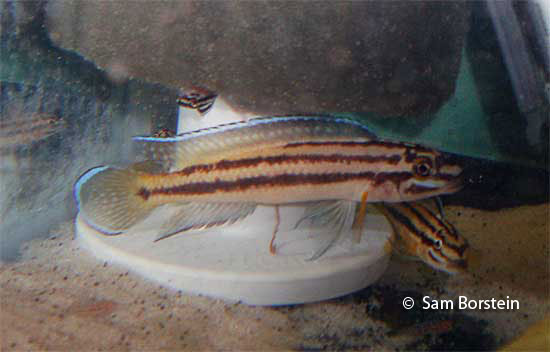
Above: A family of Julidochromis regani "Kipili". Photo by Sam Borstein.
Meaning of Name:
Genus- Julidini= a genus of saltwater wrasses this fish resembles (Greek), chromis= perch (Greek).
Species- regani= named after Charles Tate Regan, a British icthyologist.
Intro:
Julidochromis regani is a relatively small cave spawner from Lake Tanganyika that was described by Poll in 1942. Even though this fish does not have much color, it is very interesting in its behavior. The Julidichromis genus, often referred to as Julies are peaceful, and exhibit very interesting spawning behaviors. The other bonus of this fish is that it can be kept and bred in small tanks.
The Julidochromis regani has many location types. The popular ones currently:
- Kachese - Four or Five very thick black stripes, cream background. A dark fish.
- Kipili: Three thin black stripes, cream to yellow background.
- Kigoma - Four or Five very thick black stripes, cream background.
- Zambia / Sumbu - four thick black stripes, yellow background. This variety is sometimes called "Zambia Gold" or "Sumbu Gold".
- Burundi - four thick black stripes, cream background.
Distribution:
Julidochromis regani live in rocky areas of Lake Tanganyika .
Size, Maturity, and Sexual Dimorphism:
Size: Males- 4.5 inches, Females- 3.5 inches
Maturity: 2.5 inches
Sexual Dimorphism: Females are larger.
Care:
Julidochromis regani is small and peaceful fish. They will do fine in a community tank, as long as they are put with fish with similar requirements, and are also relatively peaceful. This fish likes hard, basic water, and the 50% of the tanks water should be changed every two weeks. Decorate the tanks with caves.Diet:
In the wild, this fish is an omnivore and eats crustaceans and algae. In captivity this fish is easy to feed, just give it a varied diet of flake and pellet foods.Breeding:
The whole Julidochromis complex has a lot of neat breeding behaviors. A nice thing about these fish is that they will raise numerous broods in a tank; the juvenile fish from the last spawn will even help defend the spawn.
The pair will usually spawn in a cave that has a relatively small opening. Mine bred in barnacles. The fry are small, and defended well by the parents. The fry are easily raised on baby brine shrimp, and for Tangs grow relatively fast. At about a 1/4 inch, they start to get the pattern on them. You should always feed Julies and Lamprologus baby brine shrimp because they don't let the babies out until they are relatively good size.
Conclusion:
This, along with all Julies are nice fish to keep. If you got a small tank open, give them a try.
References:
- Konings, A. (1998) Tanganyikan cichlids in their natural habitat. Cichlid Press, El Paso, Texas, 272 pp.